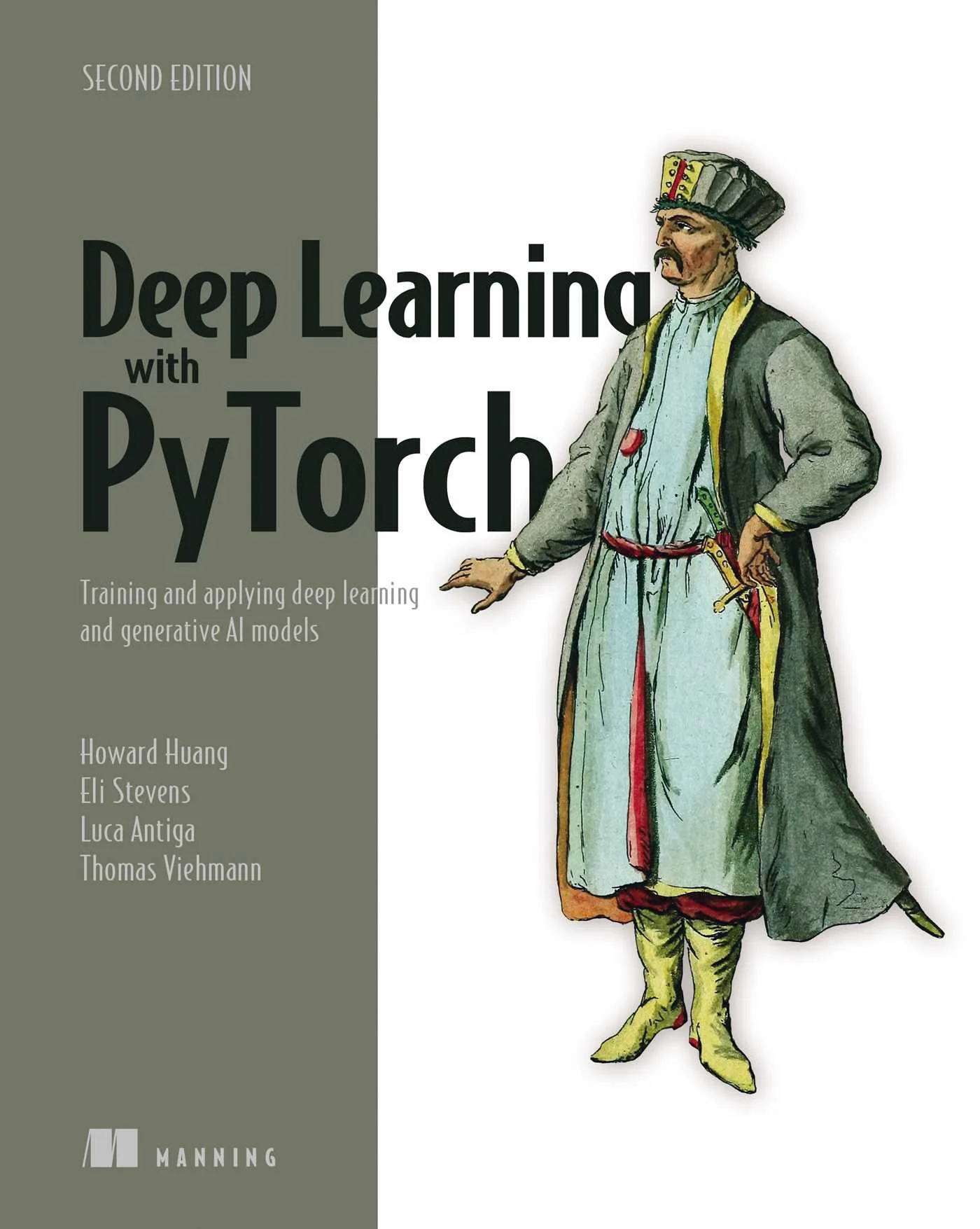
Deep Learning with PyTorch Book by Eli Stevens, Luca Antiga, and Thomas Viehmann
PyTorch core developer Howard Huang updates the bestselling original Deep Learning with PyTorch with new insights into the transformers architecture and generative AI models.
Instantly familiar to anyone who knows PyData tools like NumPy, PyTorch simplifies deep learning without sacrificing advanced features. In this book you’ll learn how to create your own neural network and deep learning systems and take full advantage of PyTorch’s built-in tools for automatic differentiation, hardware acceleration, distributed training, and more. You’ll discover how easy PyTorch makes it to build your entire DL pipeline, including using the PyTorch Tensor API, loading data in Python, monitoring training, and visualizing results. Each new technique you learn is put into action with practical code examples in each chapter, culminating into you building your own convolution neural networks, transformers, and even a real-world medical image classifier.
In Deep Learning with PyTorch, Second Edition you’ll find:
• Deep learning fundamentals reinforced with hands-on projects
• Mastering PyTorch's flexible APIs for neural network development
• Implementing CNNs, transformers, and diffusion models
• Optimizing models for training and deployment
• Generative AI models to create images and text
About the technology
The powerful PyTorch library makes deep learning simple—without sacrificing the features you need to create efficient neural networks, LLMs, and other ML models. Pythonic by design, it’s instantly familiar to users of NumPy, Scikit-learn, and other ML frameworks. This thoroughly-revised second edition covers the latest PyTorch innovations, including how to create and refine generative AI models.
About the book
Deep Learning with PyTorch, Second Edition shows you how to build neural network models using the latest version of PyTorch. Clear explanations and practical projects help you master the fundamentals and explore advanced architectures including transformers and LLMs. Along the way you’ll learn techniques for training using augmented data, improving model architecture, and fine tuning.
What's inside
• PyTorch APIs for neural network development
• LLMs, transformers, and diffusion models
• Model training and deployment
About the reader
For Python programmers with a background in machine learning.
About the author
Howard Huang is a software engineer and developer on the PyTorch library focusing on large scale, distributed training. Eli Stevens, Luca Antiga, and Thomas Viehmann authored the first edition of Deep Learning with PyTorch.
Table of Contents
Part 1
1 Introducing deep learning and the PyTorch library
2 Pretrained networks
3 It starts with a tensor
4 Real-world data representation using tensors
5 The mechanics of learning
6 Using a neural network to fit the data
7 Telling birds from airplanes: Learning from images
8 Using convolutions to generalize
Part 2
9 How transformers work
10 Diffusion models for images
11 Using PyTorch to fight cancer
12 Combining data sources into a unified dataset
13 Training a classification model to detect suspected tumors
14 Improving training with metrics and augmentation
15 Using segmentation to find suspected nodules
16 Training models on multiple GPU
17 Deploying to production
Deep Learning with PyTorch Book by Eli Stevens, Luca Antiga, and Thomas Viehmann
PyTorch core developer Howard Huang updates the bestselling original Deep Learning with PyTorch with new insights into the transformers architecture and generative AI models.
Instantly familiar to anyone who knows PyData tools like NumPy, PyTorch simplifies deep learning without sacrificing advanced features. In this book you’ll learn how to create your own neural network and deep learning systems and take full advantage of PyTorch’s built-in tools for automatic differentiation, hardware acceleration, distributed training, and more. You’ll discover how easy PyTorch makes it to build your entire DL pipeline, including using the PyTorch Tensor API, loading data in Python, monitoring training, and visualizing results. Each new technique you learn is put into action with practical code examples in each chapter, culminating into you building your own convolution neural networks, transformers, and even a real-world medical image classifier.
In Deep Learning with PyTorch, Second Edition you’ll find:
• Deep learning fundamentals reinforced with hands-on projects
• Mastering PyTorch's flexible APIs for neural network development
• Implementing CNNs, transformers, and diffusion models
• Optimizing models for training and deployment
• Generative AI models to create images and text
About the technology
The powerful PyTorch library makes deep learning simple—without sacrificing the features you need to create efficient neural networks, LLMs, and other ML models. Pythonic by design, it’s instantly familiar to users of NumPy, Scikit-learn, and other ML frameworks. This thoroughly-revised second edition covers the latest PyTorch innovations, including how to create and refine generative AI models.
About the book
Deep Learning with PyTorch, Second Edition shows you how to build neural network models using the latest version of PyTorch. Clear explanations and practical projects help you master the fundamentals and explore advanced architectures including transformers and LLMs. Along the way you’ll learn techniques for training using augmented data, improving model architecture, and fine tuning.
What's inside
• PyTorch APIs for neural network development
• LLMs, transformers, and diffusion models
• Model training and deployment
About the reader
For Python programmers with a background in machine learning.
About the author
Howard Huang is a software engineer and developer on the PyTorch library focusing on large scale, distributed training. Eli Stevens, Luca Antiga, and Thomas Viehmann authored the first edition of Deep Learning with PyTorch.
Table of Contents
Part 1
1 Introducing deep learning and the PyTorch library
2 Pretrained networks
3 It starts with a tensor
4 Real-world data representation using tensors
5 The mechanics of learning
6 Using a neural network to fit the data
7 Telling birds from airplanes: Learning from images
8 Using convolutions to generalize
Part 2
9 How transformers work
10 Diffusion models for images
11 Using PyTorch to fight cancer
12 Combining data sources into a unified dataset
13 Training a classification model to detect suspected tumors
14 Improving training with metrics and augmentation
15 Using segmentation to find suspected nodules
16 Training models on multiple GPU
17 Deploying to production
Product Information
Product Information
Shipping & Returns
Shipping & Returns
Description
PyTorch core developer Howard Huang updates the bestselling original Deep Learning with PyTorch with new insights into the transformers architecture and generative AI models.
Instantly familiar to anyone who knows PyData tools like NumPy, PyTorch simplifies deep learning without sacrificing advanced features. In this book you’ll learn how to create your own neural network and deep learning systems and take full advantage of PyTorch’s built-in tools for automatic differentiation, hardware acceleration, distributed training, and more. You’ll discover how easy PyTorch makes it to build your entire DL pipeline, including using the PyTorch Tensor API, loading data in Python, monitoring training, and visualizing results. Each new technique you learn is put into action with practical code examples in each chapter, culminating into you building your own convolution neural networks, transformers, and even a real-world medical image classifier.
In Deep Learning with PyTorch, Second Edition you’ll find:
• Deep learning fundamentals reinforced with hands-on projects
• Mastering PyTorch's flexible APIs for neural network development
• Implementing CNNs, transformers, and diffusion models
• Optimizing models for training and deployment
• Generative AI models to create images and text
About the technology
The powerful PyTorch library makes deep learning simple—without sacrificing the features you need to create efficient neural networks, LLMs, and other ML models. Pythonic by design, it’s instantly familiar to users of NumPy, Scikit-learn, and other ML frameworks. This thoroughly-revised second edition covers the latest PyTorch innovations, including how to create and refine generative AI models.
About the book
Deep Learning with PyTorch, Second Edition shows you how to build neural network models using the latest version of PyTorch. Clear explanations and practical projects help you master the fundamentals and explore advanced architectures including transformers and LLMs. Along the way you’ll learn techniques for training using augmented data, improving model architecture, and fine tuning.
What's inside
• PyTorch APIs for neural network development
• LLMs, transformers, and diffusion models
• Model training and deployment
About the reader
For Python programmers with a background in machine learning.
About the author
Howard Huang is a software engineer and developer on the PyTorch library focusing on large scale, distributed training. Eli Stevens, Luca Antiga, and Thomas Viehmann authored the first edition of Deep Learning with PyTorch.
Table of Contents
Part 1
1 Introducing deep learning and the PyTorch library
2 Pretrained networks
3 It starts with a tensor
4 Real-world data representation using tensors
5 The mechanics of learning
6 Using a neural network to fit the data
7 Telling birds from airplanes: Learning from images
8 Using convolutions to generalize
Part 2
9 How transformers work
10 Diffusion models for images
11 Using PyTorch to fight cancer
12 Combining data sources into a unified dataset
13 Training a classification model to detect suspected tumors
14 Improving training with metrics and augmentation
15 Using segmentation to find suspected nodules
16 Training models on multiple GPU
17 Deploying to production